Operations Console
Operate every agent in production from one place.
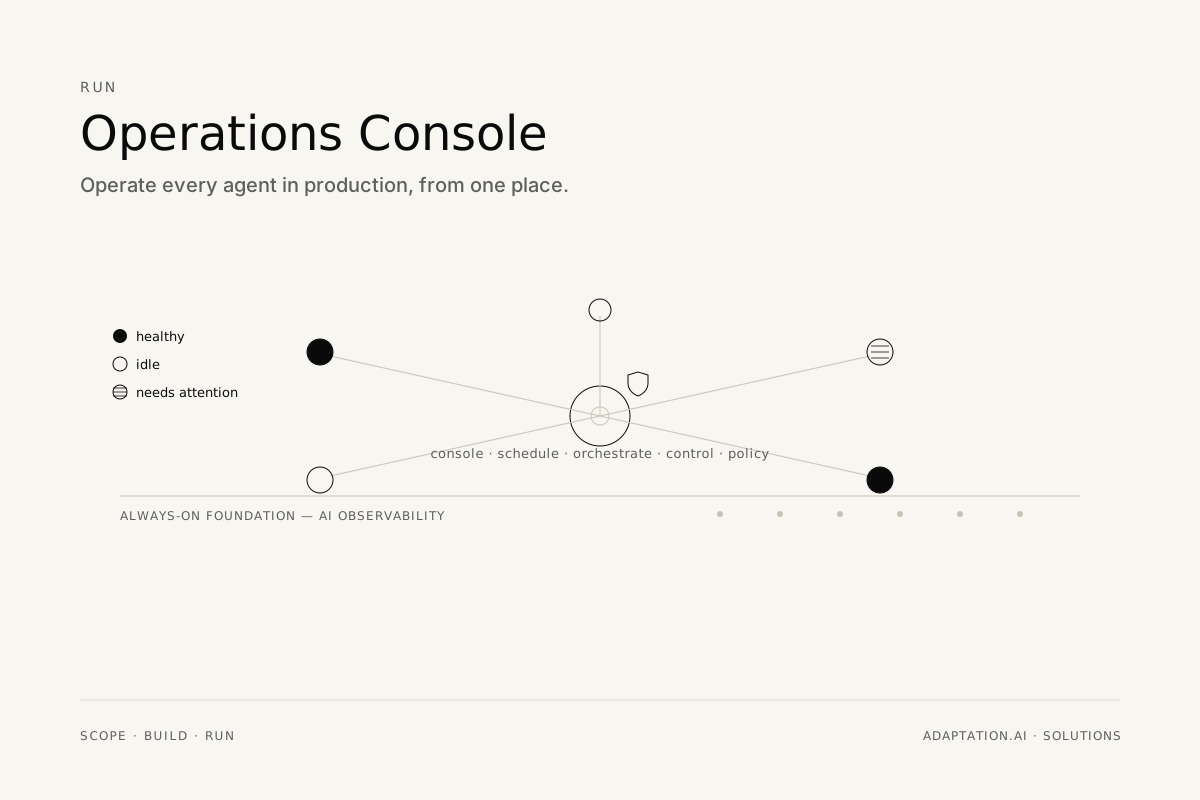
Operations Console runs your deployed agents — scheduling, orchestration, cost, and control across the whole fleet, on the monitoring foundation beneath it.
What it addresses
Agents in production drift, fail quietly, and multiply across tools until no one can say what's running, what it costs, or whether it's still behaving. Per-agent monitoring rigs don't scale, and the governance set carefully at build time erodes the moment there's no single place enforcing it.
The capabilities
Fleet dashboard
Every registered agent in one view: health, activity, cost, and policy compliance. A single pane of glass for the whole production fleet.
Scheduler + orchestrator
Time, event, and on-demand schedules, plus multi-agent sequencing that handles the dependencies between agents in a pipeline.
Policy console
Inspect and adjust each agent's runtime governance — human-in-the-loop gates, access, error-handling. Every change is audit-logged.
Cost monitor
Per-agent and fleet-level token and compute cost, with thresholds and alerts. You see what each agent costs to run.
Alert manager
Routing, escalation, runbooks, and channels (Teams, Slack, PagerDuty) so the right alert reaches the right person.
Compliance reporter
Evidence reports drawn from the audit trail and formatted for the obligations you report against — your APRA operational-risk obligations (e.g. CPS 230) and the Privacy Act. Evidence becomes a byproduct of normal operation rather than a separate project.
Wrought intake
New agents from Wrought register automatically, inheriting their governance config and metadata.
End to end
Register the fleet — deployed agents from Wrought arrive tagged with lifecycle metadata, governance config, and owner.
Schedule and orchestrate — the scheduler fires agents on their triggers and sequences multi-agent runs, evaluating dependencies before each run.
Ingest the signals — Console surfaces health, cost, quality, and drift from the AI Observability foundation into the operator view. It consumes the signals; it doesn't collect them.
Enforce the policies — at each run, the governance set in Wrought is applied — gates triggered, access checked, errors escalated per the runbook.
Route the alerts — anomalies and policy breaches go to the right target on the right channel.
Generate the reports — compliance and cost reports, on demand or scheduled, drawn from the audit trail.
How we decide which of Educate, Build, or Run fits a given piece of work is set out in our method — see how it works →
The case for it
One place for the whole fleet.
A unified fleet console in place of bespoke per-agent monitoring — the overhead doesn't climb step-for-step as the fleet grows.
Governance that carries from build to run.
Runtime enforcement continues what Wrought set at provisioning — no gap where the controls quietly stop applying.
See what your AI actually costs.
Per-agent and fleet-level cost tracking, in real time — a concrete answer to “what is this costing us”.
Compliance evidence as a byproduct.
The audit trail and reporting are designed to support your APRA operational-risk obligations (e.g. CPS 230) and the Privacy Act — evidence your auditor can assess, produced as you operate rather than in a scramble.
It gets more valuable with every agent you add.
Every agent Wrought delivers adds to one managed surface, so the return compounds as your portfolio grows.
On the lifecycle
Operations Console is the end of scope → build → run. It takes deployed agents from Wrought and runs them, sitting directly on the AI Observability foundation — what each agent did, what it cost, where it drifted. It's the software our human-led Run engagements operate with.
Prefer to work with a team rather than a tool? Our human-led Run service line runs the same phase as an engagement — distinct from the software, two sides of the same work.
What runs underneath
Beneath all three: always-on monitoring of every agent — what it did, what it cost, where it drifted. The foundation the lifecycle runs on.
Our agents connect to your tools and data over MCP — the open Model Context Protocol: connective infrastructure woven through the products, not a separate purchase.