Wrought
Provision production-ready agents from proven templates.
Wrought turns a scoped workflow into a deployed agent — built from proven templates, with governance wired in from the start, on the provider you choose.
What it addresses
Building an agent from scratch is slow, and every build reinvents the same scaffolding. Governance fares worse still: audit trails, human-in-the-loop gates, data handling — these tend to get bolted on after something goes wrong in production, which is exactly when they're hardest to add. Speed and control end up trading against each other.
The capabilities
Template composer
Browse and combine proven agent templates to match the scoped workflow; compose several patterns together for multi-step work.
Scope ingestion
Import a Workflow Compass build spec (or enter one directly) and map it to template parameters — less to configure by hand.
Governance configurator
Set the controls at build time: human-in-the-loop gates, audit-log depth, data residency, access policies. The defaults come with the template; you adjust them rather than invent them.
Provider selector
Choose where the agent runs: your existing provider, or one we host. Provider is a setting, not a rebuild — changing it later is a configuration change, not a re-engineering job.
MCP connectivity
The agent's data-source and tool connections are wired at build time over MCP (the open Model Context Protocol) — part of provisioning, not a separate post-deploy integration job.
Deployment pipeline
Automated deploy to your target (your cloud, ours, or hybrid) with a staging deploy and integration tests before anything reaches production.
Acceptance-test runner
Your own test cases run against the staged agent. Pass, and it goes live; fail, and we fund the fix.
Operations Console handoff
On go-live, the agent registers itself in Operations Console with its governance config and ownership intact — no manual re-setup.
End to end
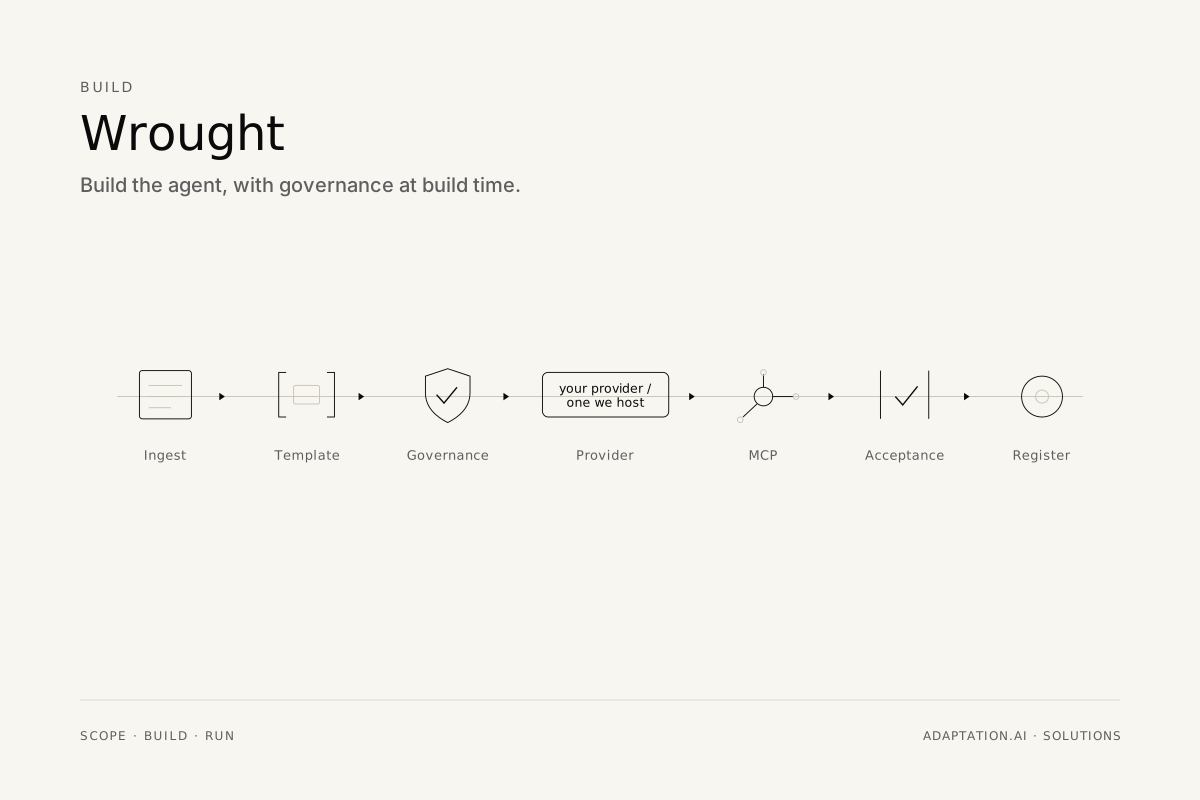
Ingest the spec — Wrought takes the build spec from Compass (or a manual one) and maps it to template parameters.
Compose the templates — the chosen patterns are composed and parameterised, then checked for internal consistency before anything is provisioned.
Pass the governance gate — human-in-the-loop gates, audit depth, data policies, and connections are configured and validated; the gate must pass before staging.
Stage and accept — the agent is provisioned in staging, integration-tested, and run against your acceptance tests.
Deploy to production — on acceptance, it deploys to your chosen target with environment-specific configuration.
Register in Operations Console — the live agent is registered with its lifecycle metadata, closing build and opening run.
How we decide which of Educate, Build, or Run fits a given piece of work is set out in our method — see how it works →
The case for it
Governance by default.
The controls are wired in at build time, as part of the template — not retrofitted after an incident.
Faster, because the patterns are proven.
Template-based provisioning puts a working version in front of you sooner, and with less risk, than a bespoke build.
A way in at zero risk.
For a buyer who's been burnt before, the acceptance test is the deal: you pay when the agent passes your own criteria. It's one way to enter a Build engagement, not a blanket promise.
Built on your stack, not locked to ours.
Wrought provisions on any provider — if you already run one, you build on it; if you don't, you get a recommendation backed by evidence.
No gap between build and run.
The Console handoff is part of the pipeline, and the governance you set here is what gets enforced in production.
On the lifecycle
Wrought is the middle of scope → build → run. It takes the build spec from Workflow Compass and hands a live, registered agent to Operations Console. It's the software our human-led Build engagements deliver with — the service line and the product are two sides of the same phase. Governance set in Wrought is enforced at run time by Operations Console, and the instrumentation it wires at build time feeds the AI Observability foundation.
Prefer to work with a team rather than a tool? Our human-led Build service line runs the same phase as an engagement — distinct from the software, two sides of the same work.
What runs underneath
Beneath all three: always-on monitoring of every agent — what it did, what it cost, where it drifted. The foundation the lifecycle runs on.
Our agents connect to your tools and data over MCP — the open Model Context Protocol: connective infrastructure woven through the products, not a separate purchase.